
A Pilates Reformer uses a spring-loaded carriage, straps, pulleys, and fixed contact points to create adjustable, directional resistance that challenges strength, mobility, and control. Users alter load by changing spring combinations, strap length reformer pilates KL, and carriage position to modify leverage and range of motion. The sliding platform and guided pathways recruit deep stabilizers and prime movers simultaneously, improving posture, proprioception, and movement efficiency. Continued exploration of settings and alignments reveals progressively nuanced training and rehabilitation benefits.

What a Pilates Reformer Is and Who It’s For
What exactly is a Pilates reformer and who benefits from using one? A Pilates reformer is a compact apparatus designed to support and challenge movement through guided, adjustable exercises. It provides a platform for precise alignment, balanced strength LA Pilates Studio KL, and enhanced mobility without prescribing one fixed outcome.
People seeking liberation from movement limitations, repetitive routines, or sedentary constraints find it valuable: dancers, athletes, rehabilitation patients, office workers, and anyone desiring adaptable training. The reformer accommodates varying intensities, aiding recovery while promoting progressive capability.
Its structured freedom allows practitioners to explore controlled range, refine posture, and regain confidence in motion. Instruction often emphasizes breath, alignment, and mindful intent, enabling individuals to reclaim autonomy over how their bodies move.
How the Reformer’s Parts Create Resistance
The reformer generates resistance through a few simple mechanical elements working in concert: springs provide adjustable load, the carriage moves along rails to translate force, the straps and pulleys change leverage and direction, and the footbar and shoulder blocks offer fixed contact points for force application.
Each component shapes how effort is felt: springs store and release energy, creating smooth opposing force; the gliding carriage allows controlled push and pull with minimal friction; straps and pulleys alter mechanical advantage, enabling varied movement paths; fixed contact points anchor the body for precise force delivery.
Together they permit progressive challenge and nuanced control, so the practitioner experiences liberated movement options while maintaining predictable, safe resistance for strength, alignment, and fluid coordination.
How to Change Load: Springs, Carriage, and Straps
The article explains how users alter load on the Reformer by changing spring combinations to increase or decrease resistance.
It notes that carriage position and travel affect leverage and the perceived difficulty of each exercise.
It also describes how strap length adjustments refine range of motion and muscle engagement.
Adjusting Spring Resistance
How should resistance be adapted to match a practitioner’s strength and exercise goals? The practitioner selects spring combinations to create a clear, progressive load—lighter for mobility and breath, heavier for strength and control. Springs attach to designated hooks; adding or removing them fine-tunes force without limiting movement.
Straps and handles alter leverage and perceived resistance, offering freedom to explore ranges safely. Considerations include experience level, joint stability, and exercise intent.
- Begin with minimal springs to prioritize alignment and ease.
- Incrementally add springs for increased muscular challenge.
- Use longer straps or different handles to change leverage, not just load.
- Reassess frequently to ensure challenge matches capacity and desired progression.
Adjustments enable liberated, individualized practice.
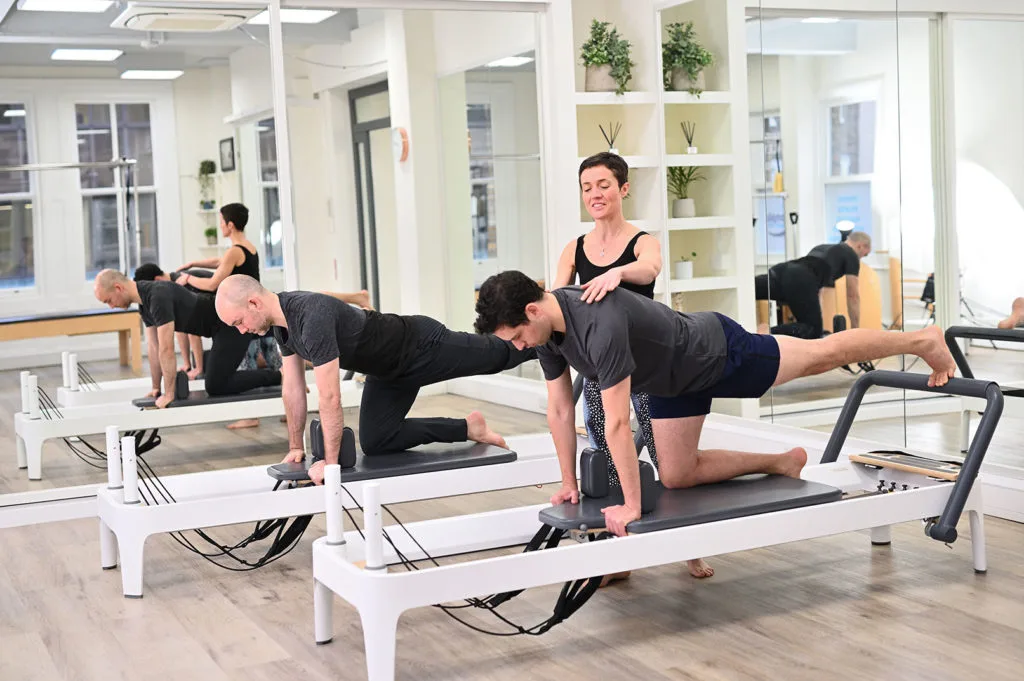
Moving The Carriage
Where does load actually come from on a reformer? It arises from the interaction of spring tension, carriage mass, and strap orientation.
Moving the carriage alters mechanical advantage: pushing or pulling it changes required force, momentum, and stability.
Introducing more springs increases resistance; removing springs lightens it.
Shifting footbar position or using different carriage anchor points reconfigures leverage, so identical springs feel distinct.
Straps and handles transmit force but do not change spring properties; their attachment points and angle influence perceived load by modifying movement path.
Skilled users adjust carriage position and spring setup to create progressive challenge or effortless flow, enabling exploration of strength, control, and range.
The system rewards precise, intentional adjustments for liberating movement.
Modifying Strap Length
Why adjust strap length at all? Changing strap length alters resistance, range, and movement rhythm, giving users control to explore strength and mobility without constraint. A technician or practitioner shortens straps for greater load and precision; lengthening offers ease and extended reach.
Attention to symmetry preserves alignment and prevents compensations. Safe adjustments respect spring settings and carriage position, and users are encouraged to experiment gradually to find liberating settings that match intent.
- Shorten for increased muscular demand and finer control.
- Lengthen for accessibility, fluidity, and longer movement arcs.
- Match lengths bilaterally to maintain balance and posture.
- Test incrementally, combining with spring choices to sculpt challenge.
Clear, intentional strap changes expand movement possibilities and autonomy.
Why the Reformer Builds Core Stability and Postural Control
Because the Reformer requires coordinated movement against variable resistance, it systematically recruits deep abdominal, pelvic floor, and spinal stabilizers to maintain alignment and control. This engagement fosters dynamic stability, allowing the body to respond to shifting loads while preserving efficient posture.
The sliding carriage and adjustable springs create continual feedback, sharpening proprioception and teaching subtle adjustments that translate to everyday movement freedom. Repeated, controlled patterns reinforce neuromuscular pathways that support upright balance and reduce compensatory tension.
Progressive challenge—changing spring tension, range, or tempo—builds resilience without forcing rigid positions, encouraging a balanced, adaptable core. Over time, improved stabilization eases breath, reduces strain on joints, and liberates movement choices, promoting confident, unrestricted activity.
How Reformers Train Stabilizers vs. Prime Movers
How do Reformers differentiate training of stabilizers from that of prime movers? The Reformer creates scenarios where small, sustained control is needed alongside larger, directional force, so stabilizers are reinforced without neglecting movers. Tension, unstable platforms, and guided pathways require coordination rather than brute strength.
Benefits include refined alignment and efficient movement.
- Controlled resistance: demands continuous micro-adjustments from stabilizers.
- Range specificity: prime movers act through clear, repeatable paths.
- Progressive challenge: alters load and complexity to favor stability or power.
- Repetition quality: reinforces neuromuscular patterns that free movement.
This approach empowers practitioners to move with autonomy, cultivating resilient cores and capable limbs that support fluid, liberated activity.
Choosing Springs and Body Positions for Your Goals (Pilates Reformer)
Spring tension choices directly alter resistance and muscle recruitment, so selecting appropriate springs is essential for matching intensity to a client’s goals.
Body alignment variations change leverage and emphasis on stabilizers versus prime movers, allowing targeted adaptations without changing equipment.
Together, thoughtful spring selection and precise positioning enable progressive, goal-specific reformer programming.
Spring Tension Choices
Which tension is chosen on the reformer directly shapes the workout’s challenge and outcomes. The practitioner selects spring combinations to modulate resistance, enabling progression, rehabilitation, or fluid movement exploration.
Lighter tension invites ease, mobility, and breath-driven flow; heavier tension demands strength, control, and precise engagement. Choices should match intent: freedom to move, rebuild capacity, or test limits.
- Few springs — promotes accessibility, range, and gentle loading.
- Moderate springs — balances stability with dynamic control.
- Heavy springs — increases muscular demand and proprioceptive feedback.
- Variable springs — allows micro-adjustments for nuanced goals.
Thoughtful selection supports personal autonomy, letting each person tailor intensity while maintaining safe, goal-oriented practice.
Body Alignment Variations
Having selected spring tension to match intent, attention shifts to body alignment variations that pair spring settings with specific positions to shape outcomes. The practitioner experiments with pelvis tilt, ribcage position, shoulder placement, and limb alignment to direct resistance along intended muscle lines.
A neutral spine emphasizes core integration; posterior tilt increases hamstring and glute engagement; anterior tilt loads the lower back and hip flexors. Rotated or side-leaning alignments target obliques and lats.
Arm and leg trajectories—straight, bent, abducted—modify leverage and challenge balance. Micro-adjustments alter sensation from stability to mobility, enabling progressive freedom in movement choices.
Thoughtful pairing of springs and alignment produces efficient, purposeful results tailored to strength, rehab, or expressive movement goals.
Common Beginner Mistakes on the Reformer : And How to Fix Them
Beginners often make predictable errors on the Pilates reformer that hinder progress and increase injury risk. Recognizing these common mistakes—such as gripping too tightly, over-tucking the pelvis, or relying on momentum—allows for targeted corrections that improve alignment, control, and results.
A detached observer notes frequent patterns and simple fixes that restore fluid, liberated movement.
- Over-gripping hands or feet — cue relaxed contact, breathe into release.
- Posterior pelvic tilt (over-tuck) — use neutral spine drills and gentle core engagement.
- Momentum-driven reps — slow tempo, focus on controlled eccentric phases.
- Holding breath or bracing — teach rhythmic breathing linked to movement.
Clear, concise corrections empower practitioners to move with more freedom and sustainable progress.
Conclusion
The Pilates reformer emerges as a versatile, evidence-informed tool that blends adjustable resistance with guided movement to enhance core stability, postural control, and coordinated strength. By targeting stabilizers differently from prime movers and allowing precise load and position modifications, it suits beginners through advanced trainees. Proper spring selection, carriage control, and technique correction avoid common errors and maximize benefit. Ultimately, consistent, mindful reformer practice yields efficient neuromuscular conditioning and improved functional movement.


